
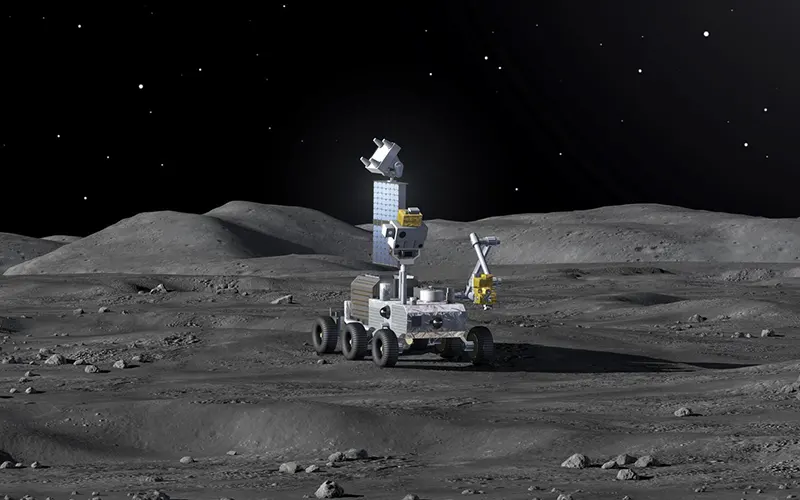
ispace-EUROPE Completes Mission Definition Review for ESA-backed MAGPIE mission, Advancing Europe’s First Lunar Polar Resource Prospecting Rover
- MAGPIE mission passes key Mission Definition Review, confirming feasibility
- European-led rover will explore the Moon’s south pole for water ice and geology
- ispace Europe leads diverse consortium to deliver a world-first science mission
LUXEMBOURG –September 10, 2025– ispace EUROPE S.A. (ispace-EUROPE) and its MAGPIE consortium partners have reached a major milestone in the Mission for Advanced Geophysics and Polar Ice Exploration, successfully completing the Mission Definition Review (MDR).
MAGPIE is a European-led lunar rover mission funded by the European Space Agency’s (ESA) small missions for exploration initiative and spearheaded by ispace-EUROPE. It will be the first in-situ European rover mission to prospect for lunar polar resources, combining advanced instruments, European engineering heritage, and a European consortium of experts to map, measure, and understand the Moon’s most valuable resources.
The mission will travel to the Moon’s south polar region to investigate the presence of water ice, map the distribution of hydrogen, and study the geological history of this unique environment. Operating in areas that remain sunlit but are close to extremely cold regions where water ice may be stable, MAGPIE will help answer fundamental questions about the Moon’s water cycle, its origins, and how such resources might be accessed in the future.
By targeting one of the most scientifically valuable and operationally challenging regions of the Moon, the mission will provide critical knowledge for sustainable exploration and in-situ resource utilisation.
The MDR marks the conclusion of pre-Phase A, during which ispace-EUROPE integrated its proven rover platform with a diverse suite of scientific instruments and tested the combined mission concept against the constraints of the polar environment. The team assessed power generation, thermal control, and mobility to ensure the rover could meet all science objectives within the mission timeline.
This comprehensive review, conducted by ESA experts, also examined the technical design of the rover and payloads, the mission operations concept, surface science objectives, development schedule, and costs. No critical or blocking actions were identified regarding the MDR objectives, allowing the project to proceed to the next phase of funding and development.
Led from Luxembourg, ispace-EUROPE is leveraging its heritage in rover development alongside a consortium that includes partners from Germany, the United Kingdom, Poland, the Czech Republic, and Norway, as well as leading research institutions such as the Technical University of Munich, The Open University, KP Labs, Czech Technical University, and CENSSS. The project demonstrates the value of collaboration between established and emerging players in the European space sector, showcasing how nations and organisations can contribute meaningfully to frontier science and exploration.

You must be logged in to post a comment.